Four on the Floor at 124 BPM: Consistency Is the Whole Groove
A kick on every quarter, steady eighth notes on the hats, snares on two and four. At 124 BPM there are 484 milliseconds between kicks, and the groove lives or d
On this page
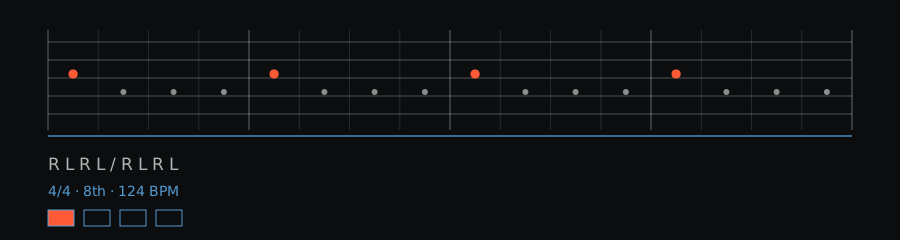
A kick on every quarter, steady eighth notes on the hats, snares on two and four. At 124 BPM there are 484 milliseconds between kicks, and the groove lives or dies on whether those four kicks are identical. This is the pattern that teaches evenness in the foot more than any exercise, and it is the pattern most often ruined by a kick drum tuned too low to speak at this tempo.
Make the four kicks identical
Record one bar and look at the waveform: four transients of the same height and shape. If the first kick is louder (common, because the foot starts fresh) or the fourth is soft (because the leg has been moving for a second), the groove will sound like it is limping even if the timing is perfect.
Practise the kick alone at 124 BPM for one minute, then with the hats, then with the snare. Building the limbs in layers means you always know which one is uneven.
The hats must not stiffen
Eighth-note hats at 124 BPM are the easiest thing in drumming to play mechanically. To keep them alive, use a small amount of wrist and let the stick fall from 8–10 cm; the motion should feel like bouncing a ball, not lifting a weight. If your forearm burns after one minute, you are lifting.
Accent the downbeat hats slightly and let the 'and' hats sit back. This is not a rule — it is a way to keep the subdivision from flattening into a machine, and it is what separates a live four-on-the-floor from a loop.
One-bar variations that do not break the floor
Variation 1: open the hats on the 'and' of four and close on the next downbeat. Variation 2: add a kick on the 'and' of four as a pickup into the next bar, keeping the four quarters intact. Variation 3: replace the last eighth of the bar with a 16th-note pair — a small fill that resolves on the downbeat.
In each case the floor pattern (four kicks) stays untouched. That is the discipline of dance drumming: variations go around the anchor, never through it.
Tempo window and tuning
The usable window for this pattern is roughly 112–132 BPM. Below 112 the eighth hats start to sound like ballads; above 132 the pattern needs 16th hats or a shaker to keep the energy, and the kick starts to feel like a single blur instead of four hits.
Tune the kick higher than you would for a slow rock groove — at 124 BPM the drum has less time to resonate, so a low fundamental never develops and the beater click becomes the whole sound. Tighten the batter head and use a hard beater for definition.
What to hold on to
- Four identical kicks per bar — the first-louder/fourth-softer pattern is what makes it limp
- Hats from a falling stick at 8–10 cm, not lifted; forearm burn means you are lifting
- Keep the four-quarter anchor intact and place variations around it
- Tune the kick higher at 124 BPM; a low fundamental never develops at this tempo