One Drop at 74 BPM: Playing the Space Instead of the Beat
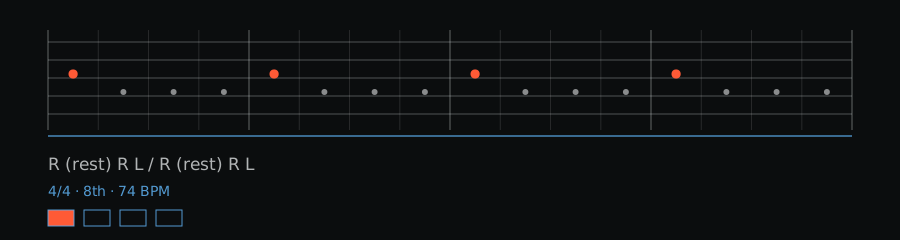
In a one drop the kick and the snare land together on beat three, and beats one, two and four are left open. At 74 BPM that means roughly 810 milliseconds betwe
On this page
In a one drop the kick and the snare land together on beat three, and beats one, two and four are left open. At 74 BPM that means roughly 810 milliseconds between beats and a lot of silence to keep steady. The pattern is the standard reggae foundation, and it fails in a specific way for drummers coming from rock: they fill the space, because the space feels like a mistake.
The kick and snare on three
The kick and snare hit together on beat three; that is the drop. Beats one, two and four have no kick and no snare, only the hi-hat or the cross-stick, usually on the third eighth of each beat — the classic reggae 'steppers' or 'rockers' feel depending on where the hat sits. Start with the hat on the 'and' of every beat, which is the skanking figure.
Play the kick-and-snare together at exactly the same instant. If the snare is 20 ms late, the drop sounds sloppy rather than heavy, because the two drums stop reinforcing each other.
Keep the space open
Count 'one, two, THREE' and let the first two beats be genuinely empty. This is the hardest part for a rock-trained foot, which wants to add a kick on one as a safety net. Play eight bars of the pattern with no kick on one at all and check the recording: any stray low thump means the reflex won.
The other discipline is not to fill with the hats. Two strokes per bar is enough; some classic recordings use a single hat stroke on the 'and' of two.
Cross-stick and rim sounds
The signature reggae snare sound is a cross-stick (side-stick), where the butt of the stick rests on the head and the shaft hits the rim. This gives a woodblock-like 'clack' without the ring of an open snare. Place the stick so about a third of it is past the rim, rest the tip lightly on the head, and strike the rim with the shaft near the shoulder.
The sound should be short and pitched, not a buzz. If you get a long ring, you are hitting the head with too much of the tip; move the tip closer to the centre of the drum to damp it more.
Tempo and feel notes
Reggae is played on the back of the beat — meaning the drop on three typically sits a few milliseconds behind the click, and the hats sit behind that. If you play it on top of the click it will sound like pop music. Practise at 74 BPM with the click and place beat three deliberately late, then record it and listen to whether it sounds lazy or heavy.
The usable window is narrow: at 84 BPM the pattern starts to feel rushed; below 66 the space between beats becomes hard to subdivide internally.
What to hold on to
- Kick and snare land together on beat three — that is the drop
- Beats one and two stay empty; a stray kick on one means a rock reflex won
- Cross-stick on the rim for the classic clack: a third of the stick past the rim, tip resting on the head
- Play on the back of the beat; the drop sits a few ms behind the click