Half-Time Shuffle at 78 BPM: Triplets With the Backbeat Halved
The shuffle feel is triplet-based: the first and third notes of each triplet are played, the middle one is skipped. Half-time means the backbeat only lands twic
On this page
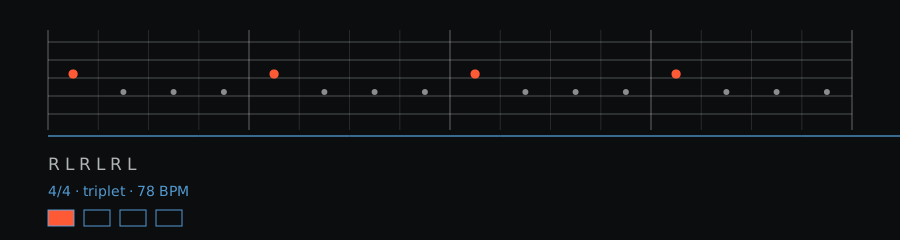
The shuffle feel is triplet-based: the first and third notes of each triplet are played, the middle one is skipped. Half-time means the backbeat only lands twice per bar instead of four times — on beat three. At 78 BPM you have 769 ms per beat, which is slow enough that the skipped middle triplet becomes a real hole in the sound rather than a bounce. This is the groove that teaches triplet subdivision properly.
Count the triplet out loud before playing it
Say 'one-trip-let, two-trip-let' for one full bar at 78 BPM while clapping only on 'one' and 'let'. What you are clapping is the shuffle: beat one and the 'let' of one, beat two and the 'let' of two. Do this for 30 seconds before touching the kit; players who try to learn the shuffle by feel alone usually end up with a dotted-eighth feel instead of a real triplet.
The difference between a shuffle and a dotted-eighth pattern matters: a dotted eighth plus sixteenth has a fixed ratio, while a shuffle's ratio moves with the player and the style. Jazz uses a ratio closer to 2:1; blues and rock shuffle often sit closer to a heavier, later third note.
Backbeat on three only
In half-time the snare lands on beat three and nowhere else. That single snare per bar is what gives the groove its weight, and it has to be exactly on the beat even though the hats around it are triplet-based and slightly late. Play the snare alone with the click for a minute: the backbeat should sound square, not shuffled.
Then add the hi-hat shuffle. The hat note on the 'let' is played from a lower stick height and is noticeably softer than the downbeat hat — a shuffle where both notes are equal sounds like a march.
Kick placement decides the style
The classic half-time shuffle kick lands on beat one and on the 'let' of two, which pushes into the snare on three. Adding a kick on the 'let' of three gives the Texas-style push; keeping the kick only on one gives a heavier rock feel. Both are legitimate; what is not legitimate is a kick that lands just before or after the 'let', because that is the one rhythmic position where a small error is audible.
Practise each kick version for two minutes and record them. The version that sounds deliberate is the one you can actually place.
Where it breaks
The most common failure is the hats drifting towards straight eighths as the tempo rises; the second is the snare on three arriving early, because the triplet feel pulls the ear forward. Both are cured by dropping to 66 BPM for one week, playing only hats and snare, and only then adding the kick.
Above roughly 96 BPM most players switch to a dotted-eighth reading of the same pattern; that is not cheating, it is a different groove, and you should decide consciously which one you are playing.
What to hold on to
- Shuffle = play the first and third of each triplet, skip the middle
- Half-time = one snare per bar, on beat three, played square
- Kick on one and on the 'let' of two for the classic push
- If the hats flatten to straight eighths, drop to 66 BPM for a week