6/8 Blues Shuffle at 92 BPM: Two Beats That Feel Like Three
In 6/8 you have two dotted-quarter beats per bar, each dividing into three eighth notes. Counting on the dotted quarter — a two feel with a triplet subdivision
On this page
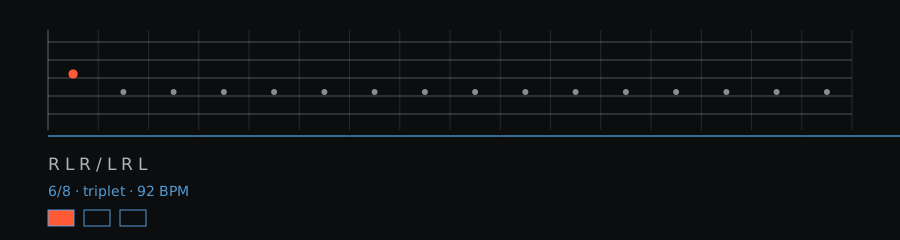
In 6/8 you have two dotted-quarter beats per bar, each dividing into three eighth notes. Counting on the dotted quarter — a two feel with a triplet subdivision — is what gives the blues shuffle its roll. At 92 BPM on the dotted quarter, each eighth is 217 ms, fast enough to swing but slow enough to place deliberately. Most drummers who struggle with 6/8 are actually counting in three and wondering why the bar keeps running out.
Count it in two, not six
The click should land on the dotted quarter: two clicks per bar. Subdivide each click into three. The written pattern is typically three strokes against the first click (ride or hat) with kick on the first and snare on the second click. If your click is on each eighth, the feel disappears — you will be counting 1-2-3-4-5-6, which reads as a waltz with a spare beat.
Try it six bars in a row while saying 'ONE-two-three, TWO-two-three'. This is worth doing out loud, because the two feel in 6/8 is a physical sensation as much as a count.
Where the backbeat sits
The snare lands on beat two (the second dotted quarter), giving one backbeat per bar. That is fewer backbeats than 4/4 and it is why 6/8 blues feels rolling rather than driving. The kick usually doubles the snare or plays beat one; the classic blues version puts the kick on beat one and a light kick under the snare.
Ghost notes between the eighth-note triplet positions are what make the pattern breathe. Keep them quiet — around a fifth of the backbeat volume — or the groove turns into mud at 92 BPM.
Fills that respect the bar length
Fills in 6/8 are usually two beats long, not four, and they almost always want to end with a triplet figure that resolves on beat one of the next bar. The most reliable fill shape is three strokes on the snare, three on the floor tom, resolved with a flam on the next downbeat. Staying inside the six keeps the bar from feeling amputated.
Practise the fill at the same 92 BPM as the groove so it does not become a separate, faster event. Fills that are played at a different tempo than the groove are the most common tell in amateur blues drumming.
The 12/8 question
6/8 and 12/8 are usually the same music notated differently: four dotted-quarter beats versus two. If a band counts it in four, you are in 12/8 and the fill logic changes to four-beat phrases. Ask which one before the first rehearsal; the two readings produce very different snare placements, and guessing wrong is heard immediately in the second bar.
Tempo guide: 6/8 blues usually sits between 72 and 116 on the dotted quarter. Below 72 it becomes a slow blues and the triplet subdivision needs more deliberate placement; above 116 it is usually played as 12/8 with a straighter feel.
What to hold on to
- 6/8 = two dotted-quarter beats per bar, each split into three eighths
- Click on the dotted quarter, never on the eighth — counting six kills the roll
- One backbeat per bar, on the second dotted quarter
- Ask whether the band counts it in two (6/8) or four (12/8) before you rehearse