12/8 Train Beat at 88 BPM: Four Beats, Each With Three
A 12/8 train beat is a shuffle counted in four: each beat has three eighths, and the ride or hat plays all three with a slight accent on the first. Played at 88
On this page
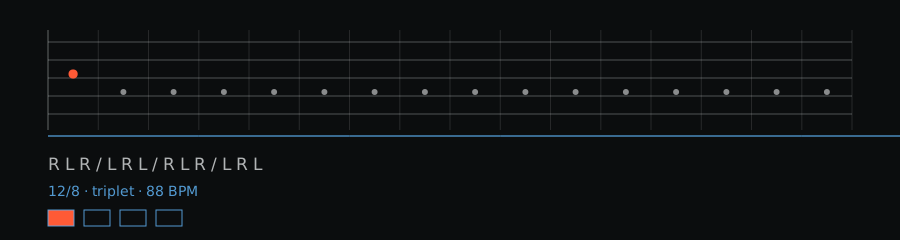
A 12/8 train beat is a shuffle counted in four: each beat has three eighths, and the ride or hat plays all three with a slight accent on the first. Played at 88 BPM on the dotted quarter, that is 293 ms per third of a beat, and the pattern's momentum comes entirely from the consistency of those triplets. This is the groove behind a large slice of blues, gospel and country-rock ballads, and it is often mistaken for a fast 4/4 shuffle.
The triplet is the beat
Play all three eighths of each beat on the ride: a strong downbeat stroke, a slightly softer middle, a slightly softer third. The subtle accent is what makes the pattern roll rather than trot. If all three strokes are equal, the groove sounds like a machine; if the accent is too strong, it sounds like a march.
The snare falls on beats two and four, with the kick doubling the downbeats. Practise the ride pattern alone for a minute before adding anything — a train beat with uneven triplets cannot be fixed later by adding the snare.
The snare's cross-stick and rim roles
In quieter 12/8 settings the snare is played as a cross-stick on beats two and four, which is why the pattern works as a ballad groove. In louder settings it is played as a full backbeat. Both use the same ride pattern; what changes is the weight. Practise the quiet version at 88 BPM until the ride is clearly the loudest element and the cross-stick is a definition point rather than a hit.
Ghost notes on the snare, played on the third eighth of beats one and three, fill in the roll without disturbing the backbeat grid.
Slow it down to hear what you are actually playing
At 88 BPM the pattern can be self-covering: the triplet subdivisions hide small errors in the backbeat. Drop to 70 BPM for a week, which gives each triplet 286 ms and makes any lateness in the snare obvious. Most players discover their snare on four is consistently early at the slower tempo and had been hiding it with speed.
The reverse exercise is also useful: at 108 BPM, play only the ride pattern with no snare and no kick, and check the triplets still land evenly. This tells you whether the subdivision is internal or just a by-product of the backbeat.
Kit application
The classic train beat uses the ride or hat triplet, snare on two and four, kick on one and three, with fills built from the same triplet subdivision — usually a triplet-based movement around the toms that resolves on beat one. Because the subdivision is triplets, a fill built from straight sixteenths will sound like a mistake; this is the most frequent error in this groove.
For hand percussion players, this is the pattern where a shaker or a tambourine on the triplet grid locks the groove together; the shaker's triplet is usually played with a softer middle stroke, exactly like the ride.
What to hold on to
- 12/8 = four beats per bar, three eighths each; count in four, feel the triplets
- Ride plays all three eighths with a light accent on the first
- Snare on two and four, cross-stick for ballads, full backbeat for louder settings
- Fills must stay inside the triplet subdivision — sixteenths sound like an error here