7/8 Groove at 108 BPM: Grouping It 2-2-3 So It Grooves
Seven eight is not inherently strange music — it is only strange when it is counted as seven. Grouped 2-2-3 it becomes a limping groove with a kick, a snare and
On this page
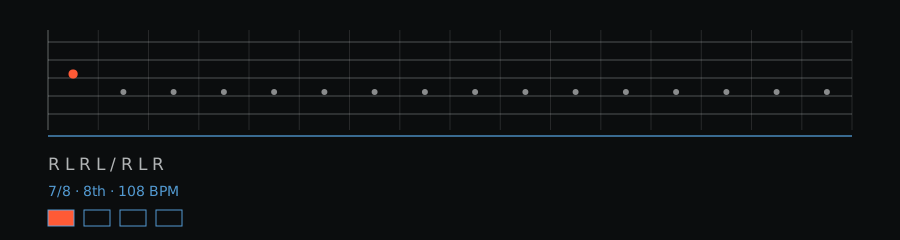
Seven eight is not inherently strange music — it is only strange when it is counted as seven. Grouped 2-2-3 it becomes a limping groove with a kick, a snare and a push, all recognisable. At 108 BPM on the eighth note, each eighth is 278 ms, and the whole bar is 1.94 seconds: long enough that a listener notices the missing eighth, short enough that the pattern still moves.
Count 2-2-3 and mark the groups with your body
Say 'one-two, one-two, one-two-three' at 108 BPM with the click on eighths. Then put the kick on the first eighth of each group and the snare on the first eighth of the 3-group: kick-kick-snare. That single bar is already a usable groove. Everything else in 7/8 is decoration on that skeleton.
Mark the groups physically: hi-hat foot down on the first eighth of each group for the first week. When the bar stops feeling like a trap, drop the foot marking.
The backbeat moves, and that is the point
Unlike 4/4, the snare does not return to the same place every two beats — it comes back after a 2-2-3 cycle, which is five eighths after the previous one. That asymmetry is what makes 7/8 sound like it is leaning. Play a simple eighth-note hat pattern with kick-kick-snare for four bars and listen to how the snare appears to arrive early the first time and on time the second.
A useful variant is 3-2-2, which moves the long group to the front. The same kick-kick-snare skeleton read as 3-2-2 has a completely different character: it feels front-heavy and works better for riff-based music.
Fills and crash placement
Because the bar is seven eighths, a fill that is built from groups of four will not resolve on beat one of the next bar. Build fills from the same 2-2-3 grid: three toms in a 3-group, two snares in a 2-group. This is why odd-meter players sound as if they never count — they are not counting, they are playing groups.
Crash on the first eighth of the next bar, not on the snare. Putting the crash on the snare makes the odd meter sound like an accident rather than a decision.
Practising without a click
Play the groove for eight bars with a click, then eight bars without, then check whether the click lands in the same place when it returns. In 7/8 the most common drift is the bar gradually shortening to 6/8 because the ear wants symmetry; if you end up a whole eighth early across eight bars, you have been cutting the 3-group to a 2.
Slow the whole exercise to 96 BPM and count out loud. Odd meters are learned by counting out loud far more than they are learned by feel.
What to hold on to
- Count 2-2-3, not 1-2-3-4-5-6-7; kick-kick-snare is the skeleton groove
- Mark the groups with the hi-hat foot until the bar stops feeling like a trap
- 3-2-2 gives the same skeleton a front-heavy character
- Build fills from 2- and 3-groups, and crash on the bar's first eighth