Linear Funk at 96 BPM: No Two Limbs at Once
Linear drumming means exactly one voice at a time: kick, snare, hats and ghost notes are sequenced rather than stacked. The payoff is clarity — every 16th note
On this page
Linear drumming means exactly one voice at a time: kick, snare, hats and ghost notes are sequenced rather than stacked. The payoff is clarity — every 16th note of the bar is a separate event, which is why linear grooves sound wide-open even at moderate tempos. At 96 BPM a 16th is 156 ms, and the whole exercise is about making the stream of single events sound like one continuous groove rather than a series of unrelated hits.
Build the stream one voice at a time
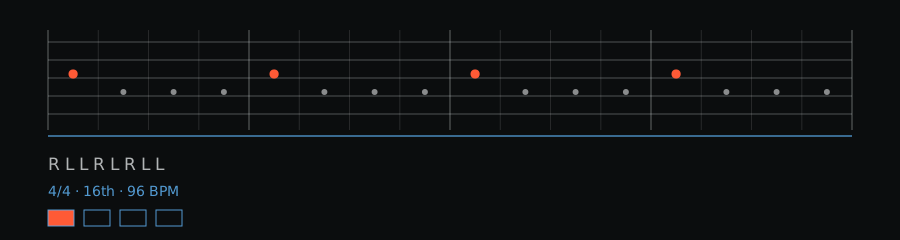
Start with a plain 16th stream on the hi-hat for one bar, then move the 'e' of two to the snare, then the 'e' of two to the snare and the 'a' of four to the kick. Each addition removes a hat note — that is what linear means. The result is a bar where nothing overlaps, and the ear hears the hi-hat pattern as continuous even though several of its notes have been replaced.
Count 'one-e-and-a' throughout. Linear playing falls apart when you stop counting, because there is no simultaneity to tell you where you are in the bar.
Dynamics carry the groove
Without stacked limbs there is no natural accent structure, so you have to build one. A working scheme for a linear funk bar: kick at 70 percent, snare backbeat at 85 percent, hat notes at 45 percent, snare ghost notes at 20 percent. Play the pattern at those levels and it will groove; play everything at the same level and it will sound like a technical exercise.
The classic test is to record one bar and check the four levels are distinguishable in the waveform. If the kick and the hats have similar peaks, the groove will sound flat no matter how accurate the timing is.
Foot independence without stacking
In a linear groove the hi-hat foot typically plays on the quarter notes, which is the only place where two sounds can coincide — and even that is optional. Try the same pattern with the foot on every quarter, then on two and four only, then with the foot silent. The version with the foot on quarters feels most grounded; the version with no foot at all feels floating and is much harder to keep steady.
This is also the drill that improves kick control fastest, because the beater has to be returned to a resting position between strokes rather than sitting against the head.
Where it is used and where it fails
Linear playing shows up in funk, in modern gospel, and in solos where the drummer wants every note audible. It fails in loud contexts because single strokes cannot generate the density that a stacked pattern can, and it fails at very slow tempos because the gaps between events become audible as gaps.
Below 84 BPM most linear patterns start to sound sparse; above 112 the 16th stream becomes a blur and the individual voices are no longer distinguishable, which removes the entire point of playing linearly.
What to hold on to
- One voice at a time: kick, snare, hats sequenced, never stacked
- Build it by replacing hat notes one at a time, counting 16ths out loud
- Accent scheme: kick 70%, backbeat 85%, hats 45%, ghosts 20%
- Usable window roughly 84–112 BPM; outside it the linear point is lost