Paradiddle-Diddle at 100 BPM: Six Notes, Two Hands, Never the Same
RLRRLL is six strokes that do not return to the starting hand at the point you expect — which is what makes it the most useful six-note grouping on the kit. At
On this page
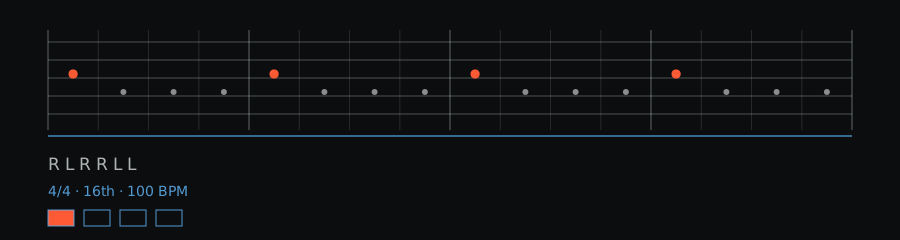
RLRRLL is six strokes that do not return to the starting hand at the point you expect — which is what makes it the most useful six-note grouping on the kit. At 100 BPM sixteenths you have 150 ms per stroke, and the double-double tail (RR LL) is where the pattern either flows or falls apart. This drill treats it as a ride pattern first, a fill second, and a solo figure third.
Feel the two halves
RLRRLL is a single stroke, a double, then a double. Play it with a slight accent on the first note and a dead-flat tail: R L R R L L. The tail is the part that has to be even; if the second R comes out late, the pattern limps for the rest of the bar.
Spend the first five minutes at 100 BPM on the pad with the metronome on sixteenths, so every stroke has a click to land on. Once the pattern is grid-locked, drop the click to quarters and keep the spacing.
This is also the pattern to use when you want a six-note fill that does not sound like a roll: because it starts and ends on different hands, it can be repeated indefinitely without a hand change.
As a ride pattern
Play RLRRLL on the ride with the right hand and move the left hand's notes to the snare: the result is a broken ride pattern that alternates cymbal and snare with an unusual grouping, common in modern gospel and fusion playing. Add the kick on beats one and three for the basic version, then displace the kick to the 'and' of two for a push feel.
Because the pattern's two halves have different densities, this ride pattern naturally accents the first note of each six, which reads as a three-against-four tension in 4/4. That tension is the reason it feels modern rather than rudimental.
As a fill
Start the pattern on the snare and move the last two strokes to the floor tom: R L R R / L L where the final pair lands on the tom. Then move the tail pair to a different drum each bar. Because the pattern is six notes, it does not fit neatly into a 4/4 bar, so fills built from it end on the 'and' of four rather than on the downbeat — a useful way to avoid the clichéd downbeat crash.
Practise the fill at 100 BPM with a click on quarter notes only and count out loud; the natural instinct is to squash the six into four.
Speed limits and doubles
Above about 130 BPM the RR LL tail becomes a true double stroke rather than two separate strokes. That transition is normal, but it must not change the spacing — check by playing the pattern at 120, 130 and 140 with a sixteenth click and listening for the tail collapsing into a bounce.
If the tail collapses early, drop back 8 BPM and play the tail with exaggerated separation for one minute. The rebound will come back on its own when the tempo is genuinely there.
What to hold on to
- RLRRLL — single stroke into two doubles, never returning to the starting hand mid-bar
- Play it as a ride pattern (right on cymbal, left on snare) for a modern broken feel
- Six notes against four beats ends on the 'and' of four — a cliché-avoiding fill
- The RR LL tail becomes a real double stroke around 130 BPM; check the spacing does not change