Flam Accent at 100 BPM: A Triplet in Disguise
fL R L / fR L R is six strokes in two groups of three, and it is the rudiment that teaches triplet feel better than most triplet exercises, because the flam lan
On this page
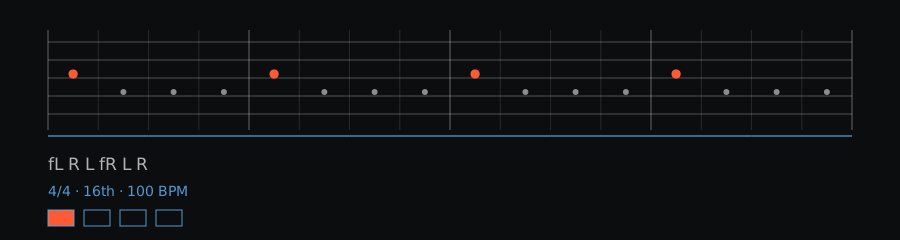
fL R L / fR L R is six strokes in two groups of three, and it is the rudiment that teaches triplet feel better than most triplet exercises, because the flam lands on the first note of each triplet and the other two notes have to be exactly even underneath it. At 100 BPM you can read it as sixteenth-note triplets (two triplets per beat) or as eighth-note triplets across two beats; both readings are used in real playing.
The triplet underneath the flam
Count 'one-flam-and-a, two-flam-and-a' or simply 'one-trip-let'. The three strokes of each group must be even in time; only the first is a flam. Play the pattern without the flams first (L R L R L R as plain triplets) and make sure it is even before adding the grace notes — a flam cannot fix an uneven triplet, it only hides it.
Once the plain triplet is clean, add the grace note. The grace note does not displace the first triplet note; it arrives just before it, so the triplet grid stays intact. Players who push the flam onto the grid end up with a four-note group and the pattern stops sounding like a triplet.
Two readings, one pattern
Reading A: eighth-note triplets, so the six strokes fill two beats — the flams land on beats one and three of the figure. Reading B: sixteenth-note triplets, so the figure repeats twice per beat and the flam lands on every other eighth. Reading B is the faster, more modern sound and the one used in drumline warm-ups; Reading A is the marching and orchestral reading.
Practise both at 100 BPM in the same session, ten reps each, and note which one you cannot keep even. The uneven one is the reading you have been avoiding, and it is usually Reading A because it exposes the second triplet's spacing.
Hand-to-hand symmetry drill
Flam accents alternate the lead hand every group, which means the left hand has to produce the same flam width as the right. Play eight reps with the right leading, then eight with the left leading, at a fixed 100 BPM. Then alternate groups RL RL without stopping and listen for the width changing.
A useful check: record both versions and compare the transient at the start of each group. If the left flam is wider, the left grace note is starting too far from the drum — lower it by a centimetre and repeat.
Applications and tempo limits
Flam accents are used as triplet fills, as a way to start a phrase on a tom, and as a snare answer in rudimental solos. On the kit, keep the flam on the snare and move the two following strokes around the toms — that figure alone will cover most of the triplet fills you will ever need.
Above roughly 150 BPM the flam has to be extremely tight to stay audible, and many players switch to an unaccented triplet there. That is a legitimate choice: knowing where your flam stops reading is part of playing it well.
What to hold on to
- fL R L / fR L R — six strokes read as two triplets with a flam on each group's first note
- Get the plain triplet even first; a flam hides unevenness rather than fixing it
- Two readings: eighth-note triplets (two beats) or sixteenth-note triplets (twice per beat)
- Above ~150 BPM most players drop the flam — know where yours stops reading