Five Stroke Roll at 60 BPM: Where Doubles Meet the Accent
The five stroke roll is two doubles and an accent — RRLLR, then LLRRL. It is the first rudiment in this book that mixes two stroke types in one gesture, and it
On this page
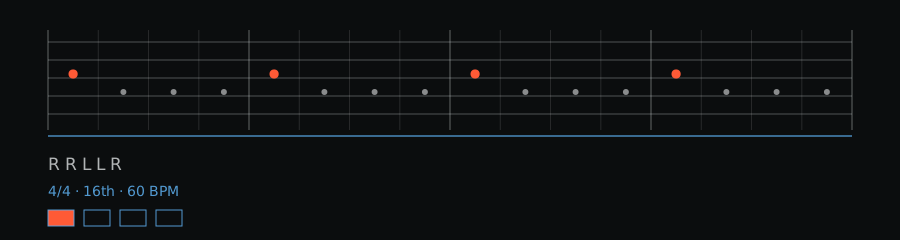
The five stroke roll is two doubles and an accent — RRLLR, then LLRRL. It is the first rudiment in this book that mixes two stroke types in one gesture, and it is where most players discover their double stroke only works at slow, even spacing. At 60 BPM the five strokes sit inside one beat as sixteenths, so the accent lands exactly on the beat and the four notes before it have to be perfectly even to sit under it.
Score it out before you play it
Written in sixteenths, the five strokes occupy the last sixteenth of the previous beat plus the first four of the next: the accent is on the beat, the four double strokes lead into it. Counting 'four-e-and-a' then 'one' is the phrase to internalise. If you can say where the accent goes while clapping the doubles, the hands will follow.
The accent makes the rudiment sound like a flam-less triplet figure in some contexts; play it cleanly and you will hear why rudimental snare writing uses five stroke rolls to punctuate phrases.
Same volume, two hands
The four unaccented notes must be indistinguishable from each other in volume and spacing; only the final accent should stand out. Test it by playing the roll without the accent at all, as a plain RRLLR figure. If it limps, the problem is in the double stroke, not in the accent.
Then test it with the accent only — play the five strokes but let the doubles drop to a whisper. If the accent then lands late, you are anticipating the loud note and shortening the fourth stroke.
Placement drills on the kit
Move the accent around the kit while the doubles stay on the snare: accent on snare, accent on rack tom, accent on floor tom, accent on hi-hat. Four bars each at 60 BPM. This is where the rudiment stops being a pad exercise: the accent hand now travels, and the doubles have to stay put.
Then invert it — doubles move to a tom, accent stays on the snare. Both versions are used constantly in fills, and the second is harder because the moving sound is the quiet one.
Tempo discipline
The five stroke roll is deceptive at speed because four of the five notes are doubles, and doubles compress well. Raise the tempo only while the accent stays exactly on the click without rushing; a common failure at 100+ BPM is the whole figure sliding a sixteenth early. Practise at 60, 72, 84, 96 and 108 in that order, two minutes each, before attempting a continuous climb.
If a tempo produces a limp, drop back one step and stay there for the rest of the session. The five stroke roll does not reward pushing.
What to hold on to
- RRLLR / LLRRL — accent on the beat, four doubles leading in
- The doubles must be even in volume before the accent is added
- Kit placement: move the accent through snare, toms and hats, then invert
- Climb in steps of 12 BPM (60/72/84/96/108), never a straight ramp