Single Stroke Roll at 40 BPM: The Tempo That Fixes Everything
Forty beats per minute is slower than most drummers can play cleanly, which is exactly why it belongs at the front of the book. At 40 BPM a single stroke roll i
On this page
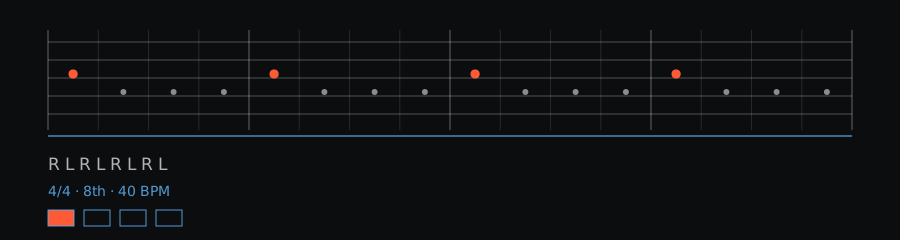
Forty beats per minute is slower than most drummers can play cleanly, which is exactly why it belongs at the front of the book. At 40 BPM a single stroke roll is eight strokes per bar in 4/4, one stroke every 750 milliseconds. That gap is long enough to hear the difference between your right hand and your left hand, and long enough that you cannot hide a stroke behind the next one. This drill is the calibration pass: it sets stroke height, rebound control and evenness before any speed work starts.
What 40 BPM actually asks of you
At 40 BPM with eighth notes you have 1500 ms between beats and 750 ms between strokes. Most players find that uncomfortable, because the reflex they have built at 120 BPM wants to fire early. The first job is not speed, it is patience: let the click land, then strike, rather than striking and hoping the click agrees.
Count out loud while you play — 1 and 2 and 3 and 4 and. Counting is what keeps the subdivisions honest; if you stop counting, the hands average out into an uneven pulse that a metronome will not correct for you.
Set the height before you set the tempo
Pick one of three stroke heights and stay there for the whole drill: low (about 5 cm above the pad), middle (12 cm), or full (20 cm). Height controls volume, rebound and how much wrist you need. Switching heights mid-bar is the single most common reason a slow roll sounds uneven.
Keep the bead path vertical. A stroke that travels forward and back as well as up and down loses energy to the pad surface and produces a thinner sound. A cheap check: put a coin on the pad, play 16 strokes around it and see whether it moves. If it does, your sticks are travelling sideways.
A four-minute cycle you can repeat daily
Minute 1: quarter notes only, one stroke per click, alternating hands, counting out loud. Minute 2: eighth notes, still at 40, full stroke height. Minute 3: eighth notes with an accent on every downbeat — R L R L R L R L becomes loud-soft-soft-soft repeating. Minute 4: sixteenth notes, two strokes per hand position, watching that the second stroke of each pair matches the first in volume.
Only when all four minutes are even should you move the dial. Step up by 4 BPM, not by 10: at these speeds a 4 BPM change is audible immediately, and it keeps you honest about where the unevenness starts.
The four faults that only appear at slow tempos
- The bounce cheat: letting the stick fall twice from one motion. You will hear a doubled note that sits behind the click. 2) The elbow flap: elbows lift to gain volume instead of using the wrist and fingers. 3) The death grip: the back fingers clamp the stick so rebound has nowhere to go, and the sound flattens. 4) The accent drift: the accent slides from the downbeat to the second stroke of the pair as the minute goes on.
Record 30 seconds on a phone at the end of each week. Slow practice is for building the reference; the recording is how you find out whether the reference is actually even.
What to hold on to
- 40 BPM in 4/4 with eighth notes = 8 strokes per bar, one every 750 ms
- Stay at one stroke height for the whole drill: 5 cm, 12 cm or 20 cm
- Accent the downbeats in minute 3 (loud-soft-soft-soft)
- Step up 4 BPM at a time; a 10 BPM jump hides the fault you were fixing